Gaspard Abel

About me

I am a PhD student in Applied Mathematics at Centre Borelli, Ecole Normale Supérieure Paris-Saclay, in the CHArt[S] research team. I am also attached to the Centre D'Analyse et de Mathématiques Sociales (CAMS), EHESS.

My PhD project revolves around diffusion processes in graphs, especially in the context of information diffusion in social networks. I am supervised by Julien Randon-Furling, Jean-Pierre Nadal and Argyris Kalogeratos.

GitHub CV

Drawing of Gaspard Abel's profile
My profile drawn by @mathilde.207

My research interests are numerous: (click one to find the related projects)

  • Temporal point processes
  • Diffusion on graphs
  • Social networks
  • Multilayer networks
  • Computational social science
  • Graph neural networks
  • Dynamical systems
  • Representation learning
  • Machine learning
  • Epidemic processes
  • Curriculum learning
  • Transformers
  • Reinforcement learning
  • Algorithmic pricing

Research

Publications

  1. Accepted ICML 2026 spotlight
    Beyond ReLU: Bifurcation, Oversmoothing, and Topological Priors

    Erkan Turan, Gaspard Abel, Maysam Behmanesh, Emery Pierson, Maks Ovsjanikov.

  2. Accepted IEEE Transactions on Computational Social Systems 2026
    Uncovering Social Network Activity Using Joint User and Topic Interaction

    Gaspard Abel, Argyris Kalogeratos, Jean-Pierre Nadal, Julien Randon Furling.

  3. Submitted IEEE Transactions on Network Science and Engineering 2026
    Reducing Recurrent Competitive Epidemics via Dynamic Resource Allocation

    Argyris Kalogeratos, Gaspard Abel, Stefano Sarao Mannelli.

  4. Submitted ECML PKDD 2026
    Dual-Criterion Curriculum Learning: Application to Temporal Data

    Gaspard Abel, Eloi Campagne, Mohamed Benloughmari, Argyris Kalogeratos.

  5. Preprint To be submitted 2026
    Algorithmic collusion under asynchronous price updating

    Ivan Conjeaud, Gaspard Abel, Argyris Kalogeratos.

Selected talks

2026

  • CJCMA 2026

    Congrès des Jeunes Chercheur•es en Mathématiques Appliquées. Conference for Young Applied Maths scientists.

    2-4 March · Champs-sur-Marne

2025

Projects

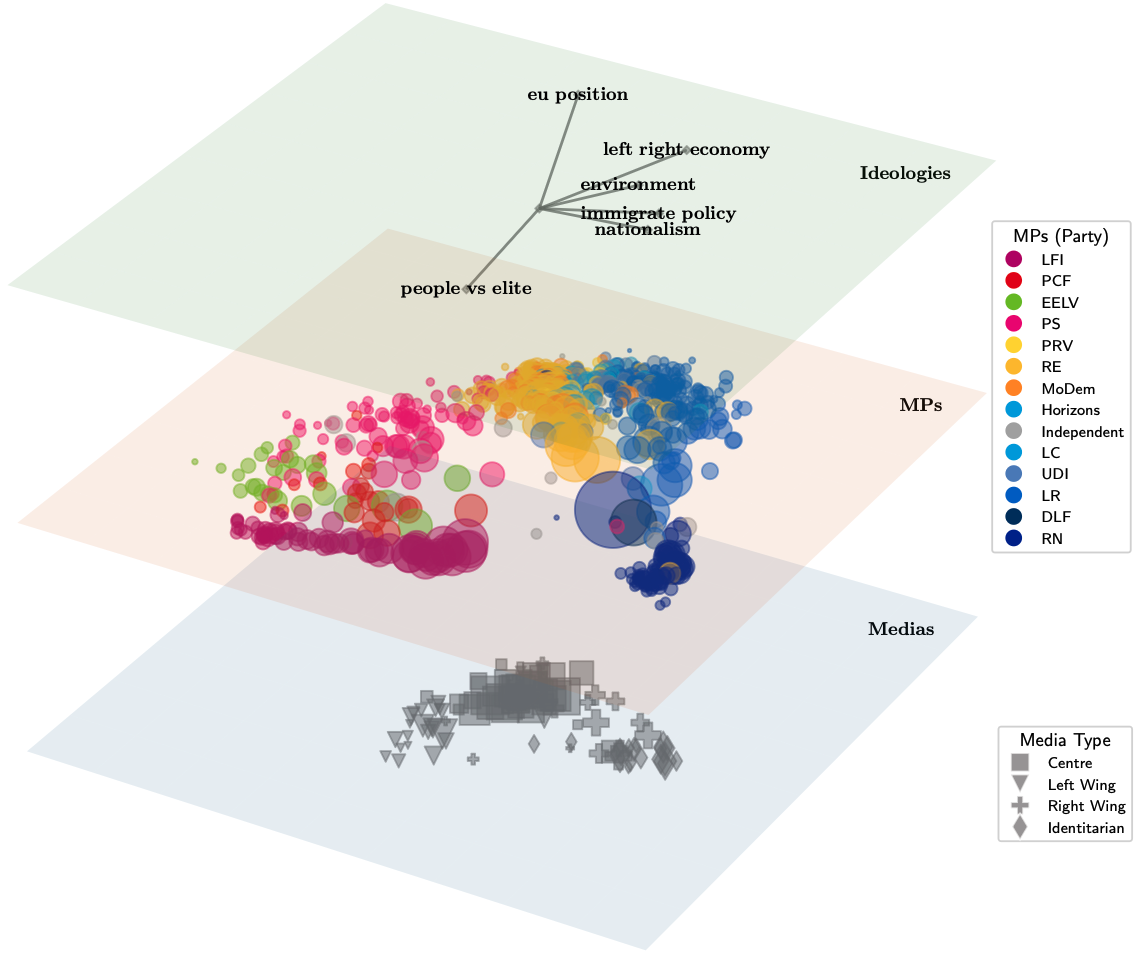
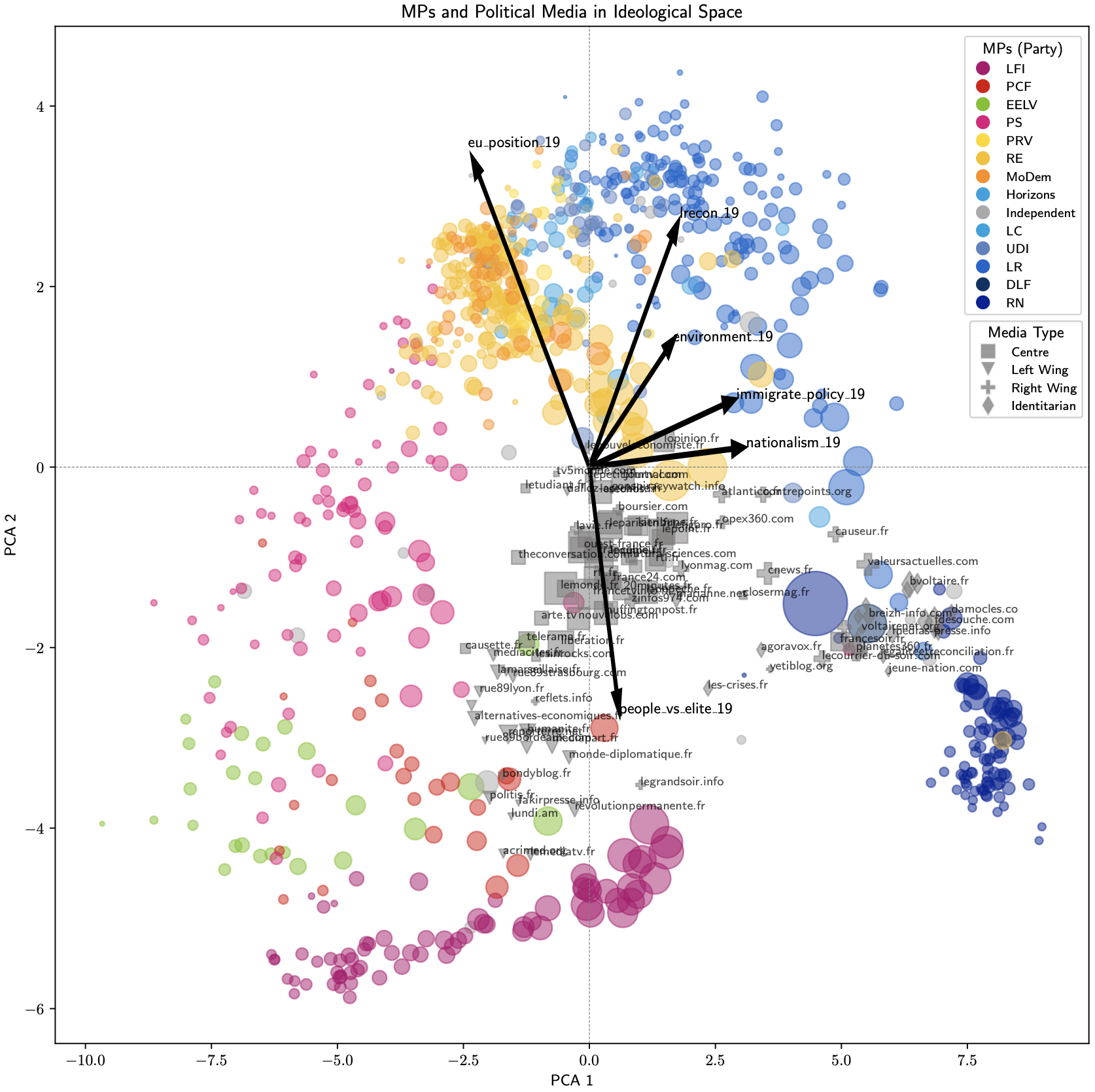
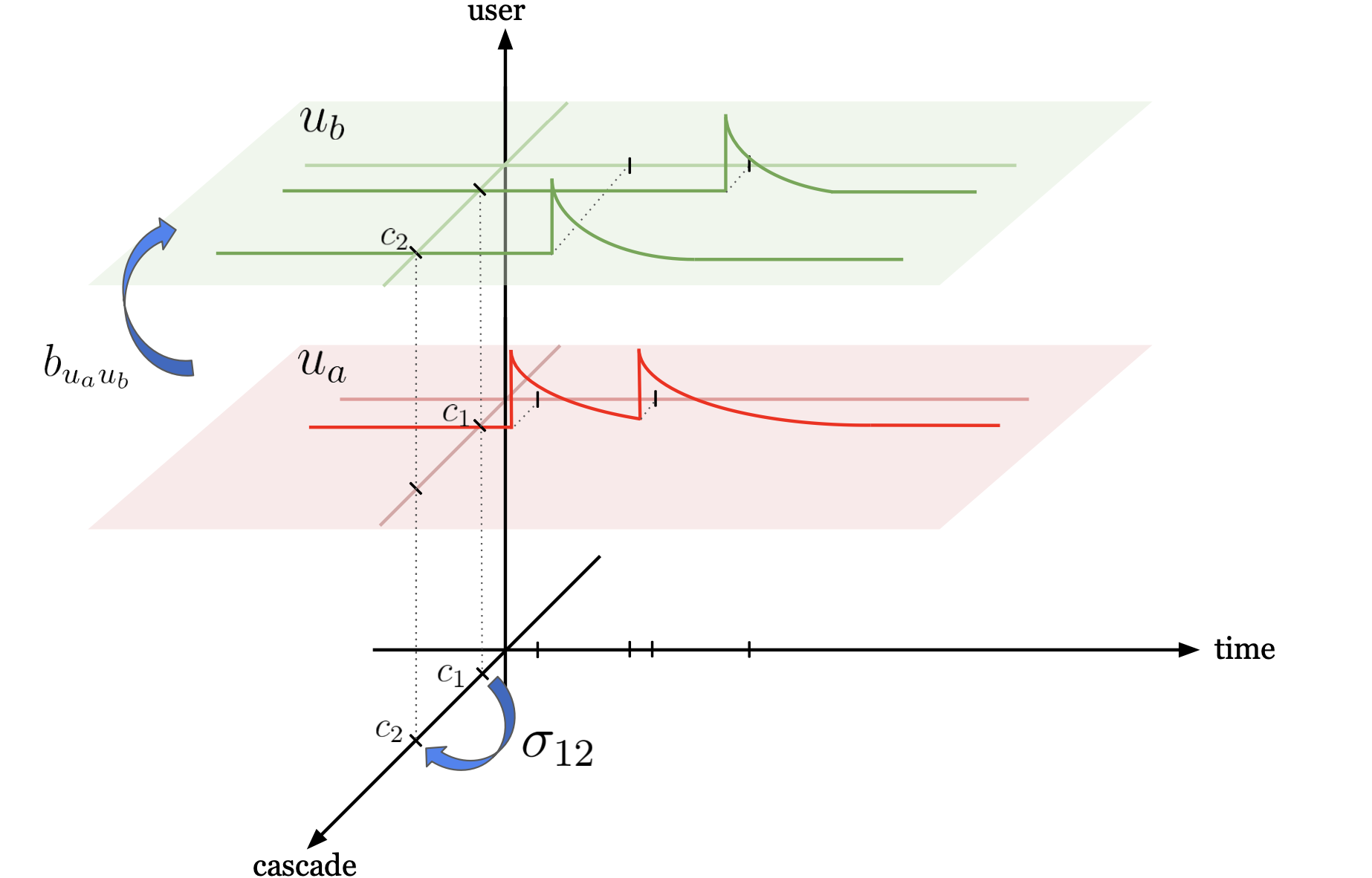
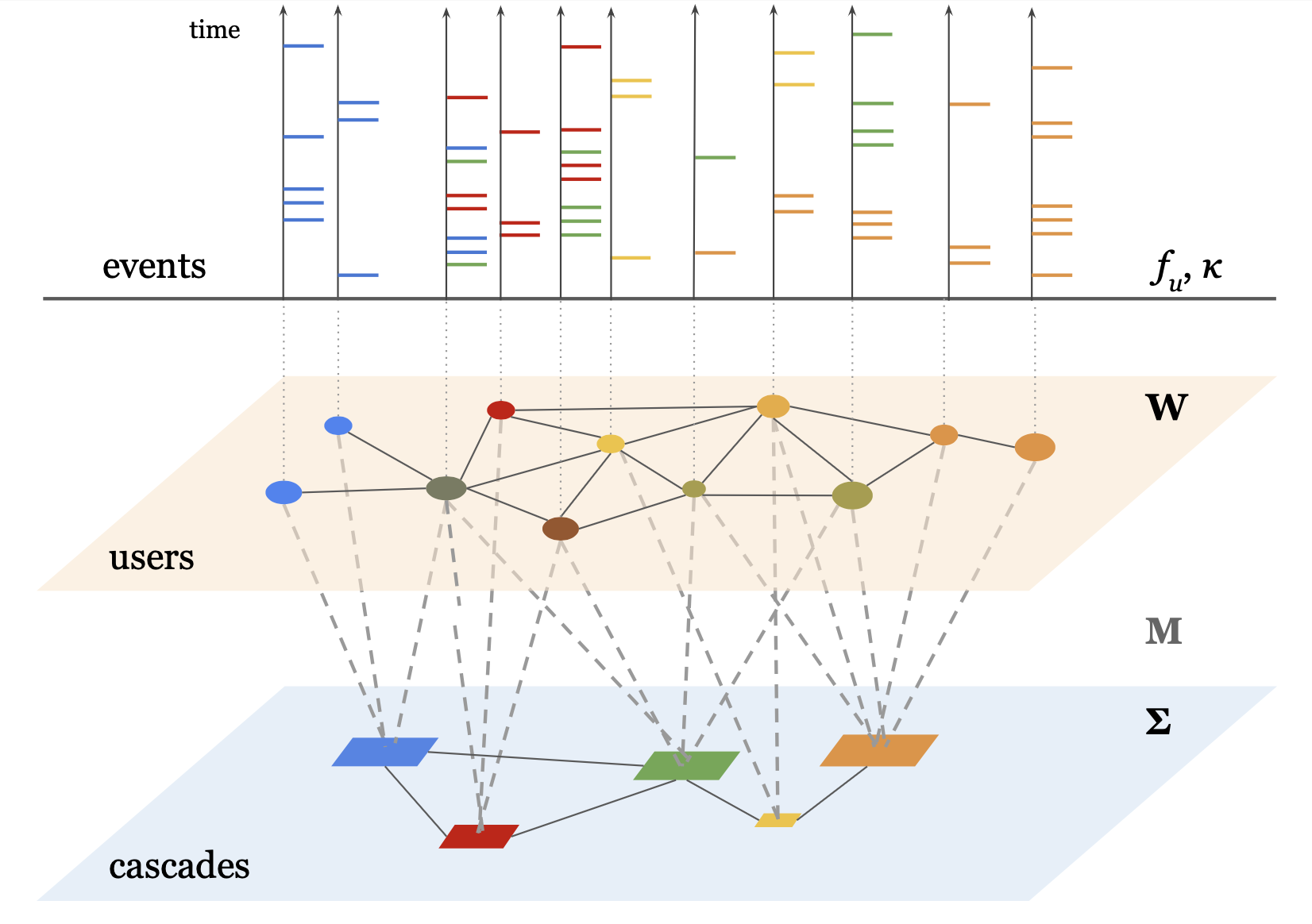
Conceptual view of the model Layered visualization of the MIC model
Conceptual view of the MIC model

01

Temporal Point Processes for information diffusion in social networks

This project focuses on the interplay between the dynamics of information diffusion in social networks and the content of the information spread. To model this, we use Multidimensional Marked Hawkes Processes, which are a class of Temporal Point Processes.

  • Temporal point processes
  • Diffusion on graphs
  • Social networks
  • Multilayer networks
  • Temporal data

PaperUncovering Social Network Activity Using Joint User and Topic Interaction, IEEE Transactions on Computational Social Systems, 2026.

The emergence of online social platforms, such as social networks and social media, has drastically affected the way people apprehend the information flows to which they are exposed. In such platforms, various information cascades spreading among users is the main force creating complex dynamics of opinion formation, each user being characterized by their own behavior adoption mechanism. Moreover, the spread of multiple pieces of information or beliefs in a networked population is rarely uncorrelated. In this paper, we introduce the Mixture of Interacting Cascades (MIC), a model of marked multidimensional Hawkes processes with the capacity to model jointly non-trivial interaction between cascades and users. We emphasize on the interplay between information cascades and user activity, and use a mixture of temporal point processes to build a coupled user/cascade point process model. Experiments on synthetic and real data highlight the benefits of this approach and demonstrate that MIC achieves superior performance to existing methods in modeling the spread of information cascades. Finally, we demonstrate how MIC can provide, through its learned parameters, insightful bi-layered visualizations of real social network activity data.
02

A visualization tool for multilayer networks

MultilayerNetViz is a lightweight python module for the visualization of complex networks. It allows to represent the interactions within and between different layers of the network. This is especially useful for the study of socio-semantic networks. The package and documentation can be found on its GitHub repository.

  • Multilayer networks
  • Visualization
  • Social networks
  • Computational social science
  • Python

MultiLayerNetViz

Visualization examples

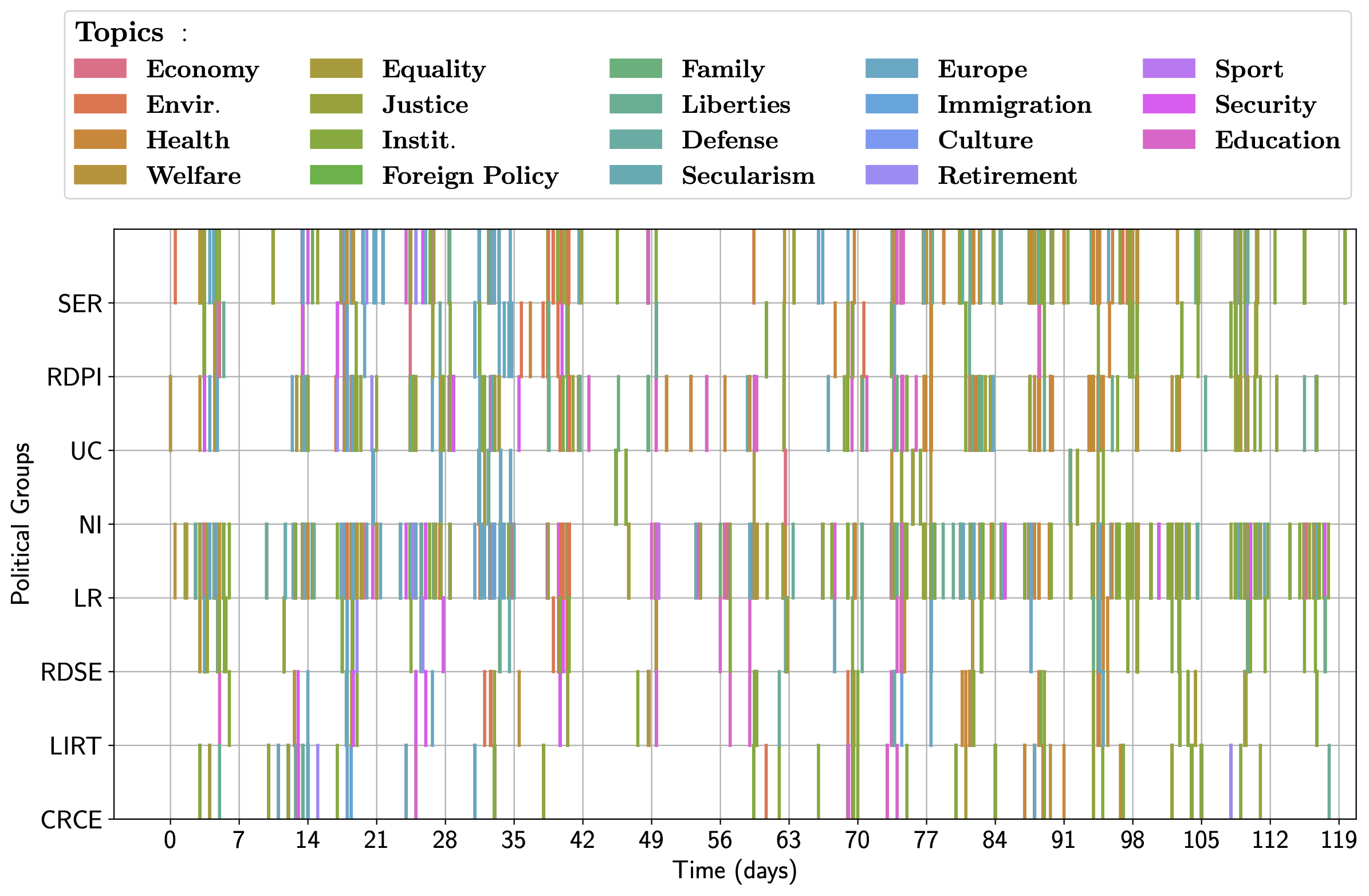
Temporal unfolding of the senate groups political activity
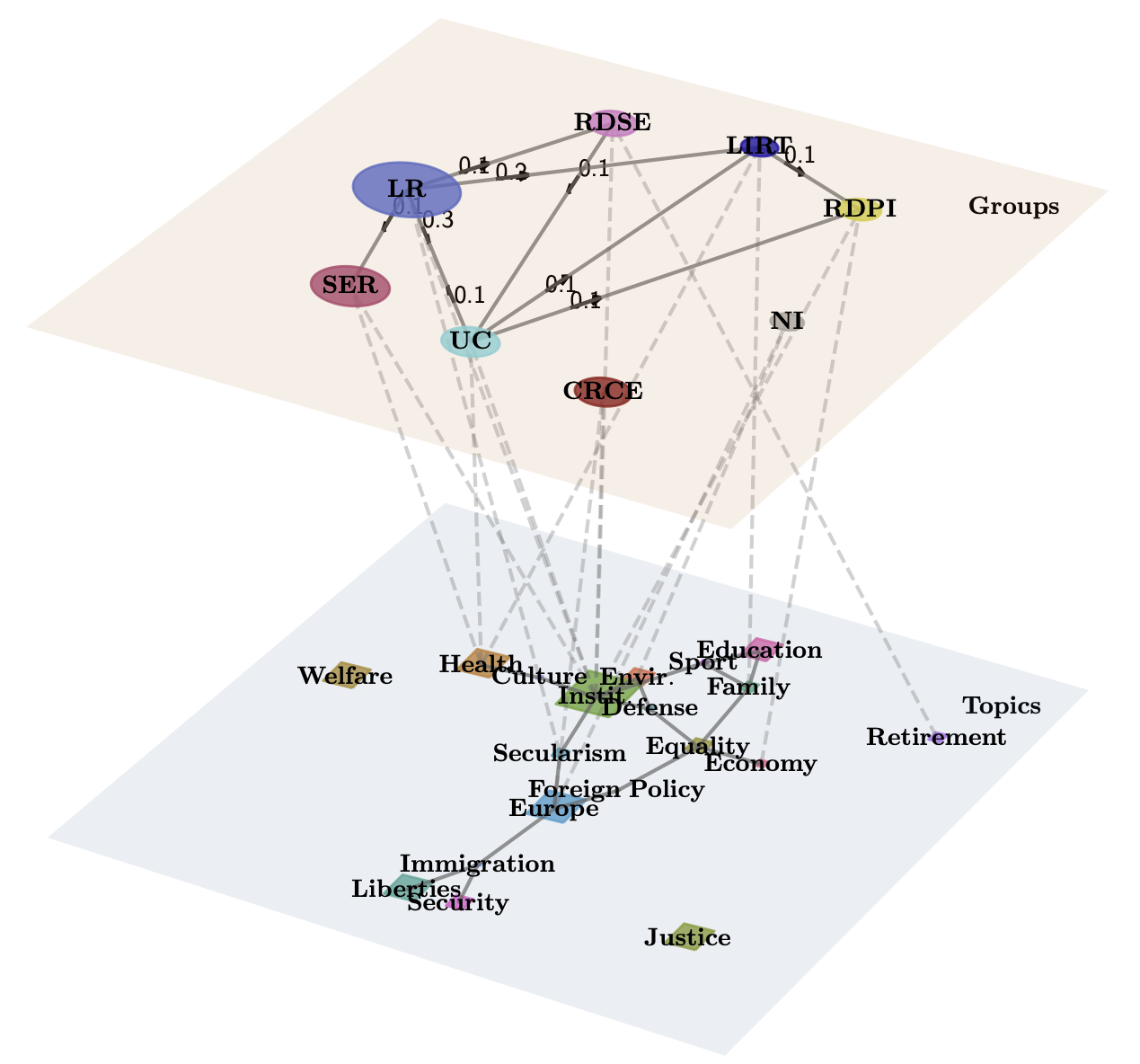
French senate and topic of amendments bi-layer network

The legislative process of the French Senate is characterized by a complex interplay of various factors, including political agendas, public opinion, and institutional dynamics. As seen on the occurrence of proposed amendments over time, there is a strong temporal clustering of legislative activities, across every political group. After training the Mixture of Interacting Cascades model on this data, the inferred parameters can be exploited to qualitatively describe information diffusion landscape. A rich structure of interactions between different political actors can be observed, as well as on the topic of bills proposed.

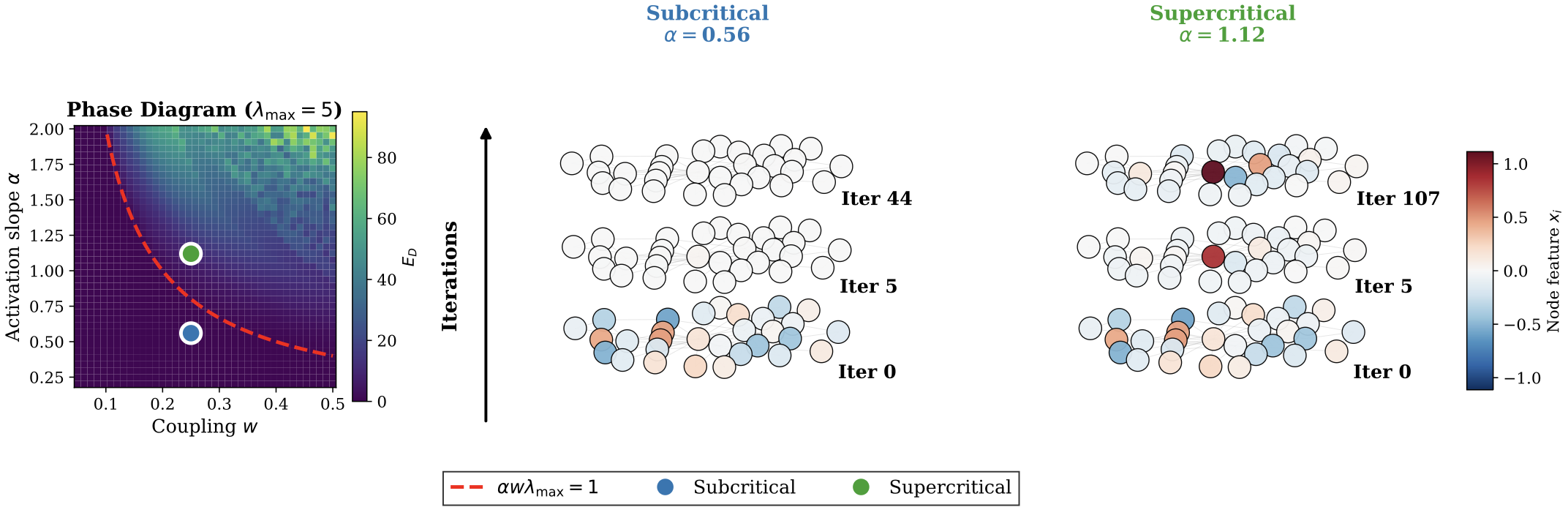
Distinct regimes of GNN learning dynamics
Distinct regimes of GNN learning dynamics.

03

A dynamical system approach to oversmoothing in GNNs

This project focuses on the phenomenon of oversmoothing in Graph Neural Networks (GNNs), which occurs when the representations of nodes in a graph become indistinguishable after multiple layers of message passing.

  • Graph neural networks
  • Diffusion on graphs
  • Dynamical systems
  • Representation learning
  • Machine learning

PaperBeyond ReLU: Bifurcation, Oversmoothing, and Topological Priors, accepted at ICML 2026 (spotlight).

Graph Neural Networks (GNNs) learn node representations through iterative network-based message-passing. While powerful, deep GNNs suffer from oversmoothing, where node features converge to a homogeneous, non-informative state. We re-frame this problem of representational collapse from a bifurcation theory perspective, characterizing oversmoothing as convergence to a stable “homogeneous fixed point.” Our central contribution is the theoretical discovery that this undesired stability can be broken by replacing standard monotone activations (e.g., ReLU) with a class of functions. Using Lyapunov-Schmidt reduction, we analytically prove that this substitution induces a bifurcation that destabilizes the homogeneous state and creates a new pair of stable, non-homogeneous patterns that provably resist oversmoothing. Our theory predicts a precise, nontrivial scaling law for the amplitude of these emergent patterns, which we quantitatively validate in experiments. Finally, we demonstrate the practical utility of our theory by deriving a closed-form, bifurcation-aware initialization and showing its utility in real benchmark experiments.

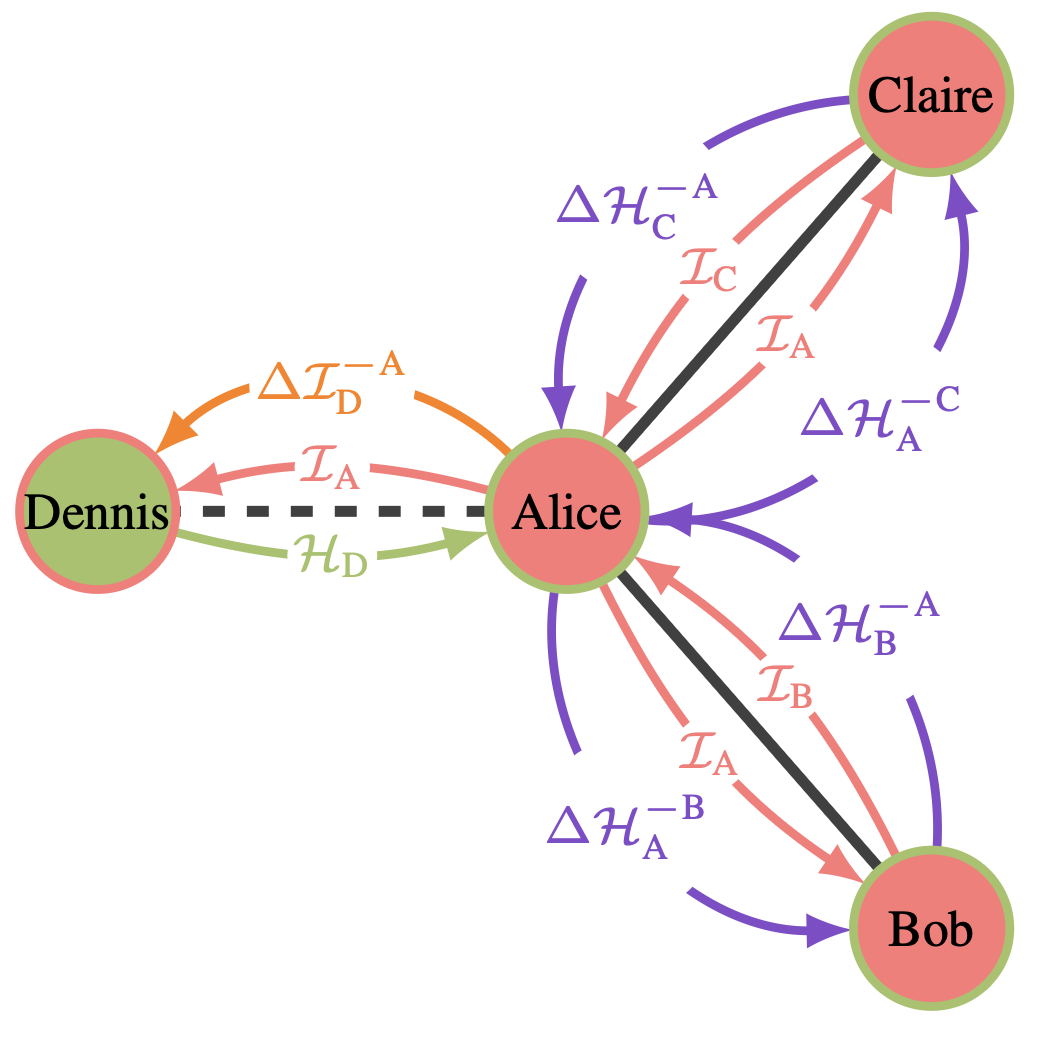
Contact network with competitive transmission rates
Contact network with competitive transmission rates.

04

Dynamic Resource Allocation for Recurrent Epidemics

This project proposes a greedy algorithm for dynamic resource allocation for recurrent and competitive epidemics.

  • Epidemic processes
  • Diffusion on graphs
  • Social networks
  • Resource allocation
  • Competition

PaperReducing Recurrent Competitive Epidemics via Dynamic Resource Allocation, submitted to IEEE Transactions on Network Science and Engineering.

Motivated by scenarios of epidemic competition, as well as how social contagions spread at the level of individuals, this work considers the competition between two conflicting node states that spread over a social graph according to a generic diffusion process. For this setting, we introduce the Generalized Largest Reduction in Infectious Edges (gLRIE), which is a dynamic resource allocation strategy that favors the preferred state against the other. Our analysis assumes a generic continuous-time SIS-like (Susceptible-Infectious-Susceptible) diffusion model that allows for: arbitrary node transition rate functions for nodes to change state, and competition between the healthy (positive) and infected (negative) states, which are both diffusive at the same time, yet mutually exclusive at each node. The strategy follows a minimum-risk-maximum-gain principle, and its features are particularly relevant for social contagion phenomena. In accordance with the LRIE strategy that we generalize, we show that in this context the gLRIE strategy remains a greedy solution for the minimization of the number of infected network nodes over time. Ultimately, simulations are employed to compare the proposed strategy with other existing alternatives, demonstrating that gLRIE exhibits superior performance across a spectrum of scenarios, including a realistic counter-contagion campaign in a small well-monitored community.

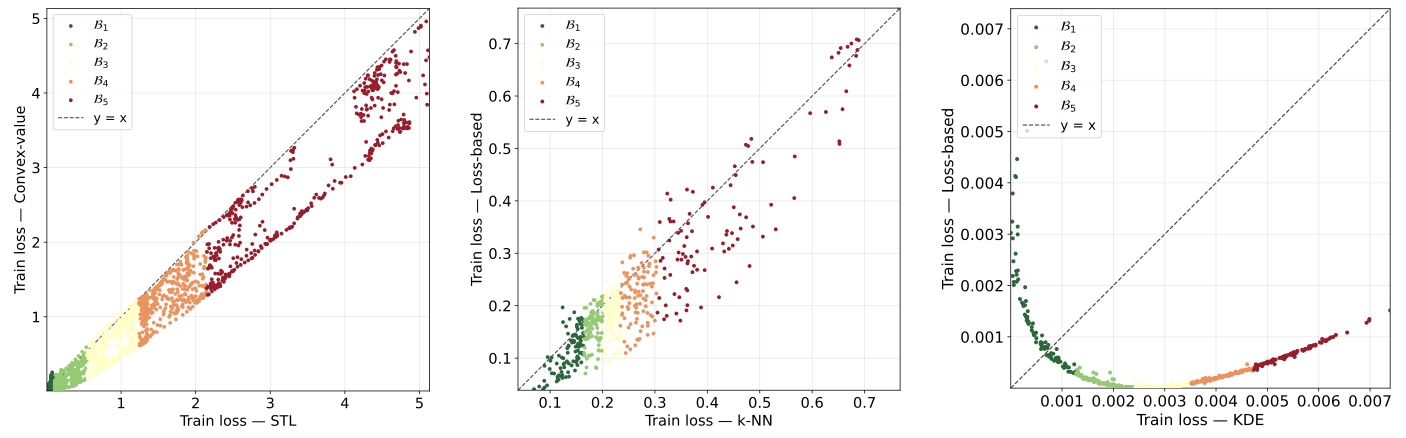
Scatterplot of instance difficulty for different Curriculum Learning strategies
Scatterplot of instance difficulty for different Curriculum Learning strategies.

05

Density and Loss-based Curriculum Learning for Temporal Data Analysis

This project investigates how density and loss-based strategies can provide complementary criterion for difficulty assessment in Curriculum Learning. We propose a modular framework to study this and evaluate on a time-series forecasting task.

  • Curriculum learning
  • Temporal data
  • Representation learning
  • Transformers
  • Machine learning

DraftDual-Criterion Curriculum Learning: Application to Temporal Data.

Curriculum Learning (CL) is a meta-learning paradigm that trains a model by feeding the data instances incrementally according to a schedule, which is based on difficulty progression. Defining meaningful difficulty assessment measures is crucial and most usually the main bottleneck for effective learning, while also in many cases the employed heuristics are only application-specific. In this work, we propose the Dual-Criterion Curriculum Learning (DCCL) framework that combines two views of assessing instance-wise difficulty: a loss-based criterion is complemented by a density-based criterion learned in the data representation space. Essentially, DCCL calibrates training-based evidence (loss) under the consideration that data sparseness amplifies the learning difficulty. As a testbed, we choose the time-series forecasting task. We evaluate our framework on multivariate time-series benchmarks under standard One-Pass and Baby-Steps training schedules. Empirical results show the interest of density-based and hybrid dual-criterion curricula over loss-only baselines and standard non-CL training in this setting.

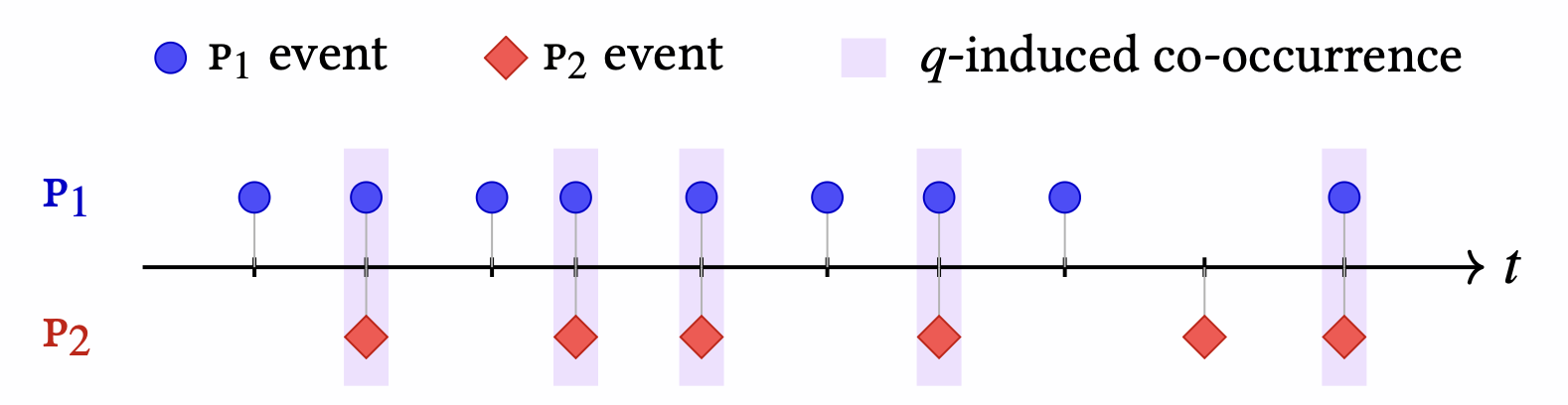
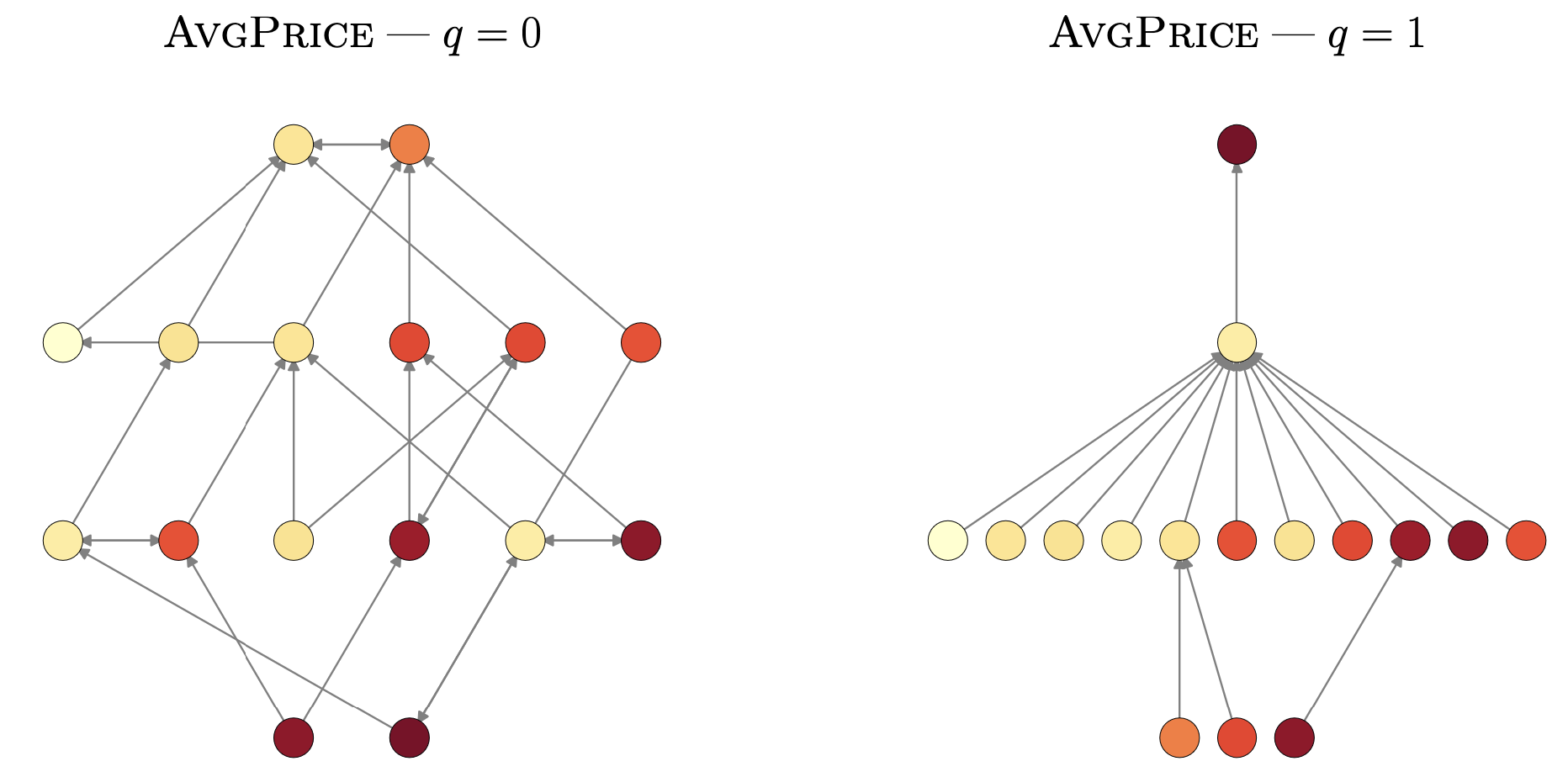
Schematic illustration of the asynchronous action selection process Response graphs for different values of asynchrony
Schematic illustration of the asynchronous action selection process (top). Response graphs for different values of asynchrony (bottom).

06

Algorithmic collusion under asynchronous price updating

This project explores the effect of asynchrony in the learning behavior of algorithmic pricing agents.

  • Reinforcement learning
  • Algorithmic pricing
  • Competition
  • Temporal point processes
  • Machine learning

DraftAlgorithmic collusion under asynchronous price updating.

This paper investigates the effect of asynchrony in agents' updates in the emergence of algorithmic collusion. We present a continuous-time model for algorithmic collusion in which two firms use Q-learning algorithms to set prices asynchronously in a Bertrand duopoly. The firms update their prices at times dictated by a Poisson clock. By controlling the extent of agents' asynchrony, we run extensive numerical experiments with three specifications of the algorithm to investigate the emergence of algorithmic collusion. The strength of collusion is measured by a standard collusion index, as well as by automatically detecting the reward-punishment schemes. This is done by recording a large number of algorithms' reactions to unilateral price cuts and comparing them with the reactions of untrained algorithms. Our findings indicate that asynchrony hampers collusion, especially when the algorithms are stateless. When they condition on their competitor's previous prices, the sensitivity of algorithmic collusion to asynchrony varies depending on the type of information they have access to. The implications of these results for the regulation of algorithmic pricing are discussed.

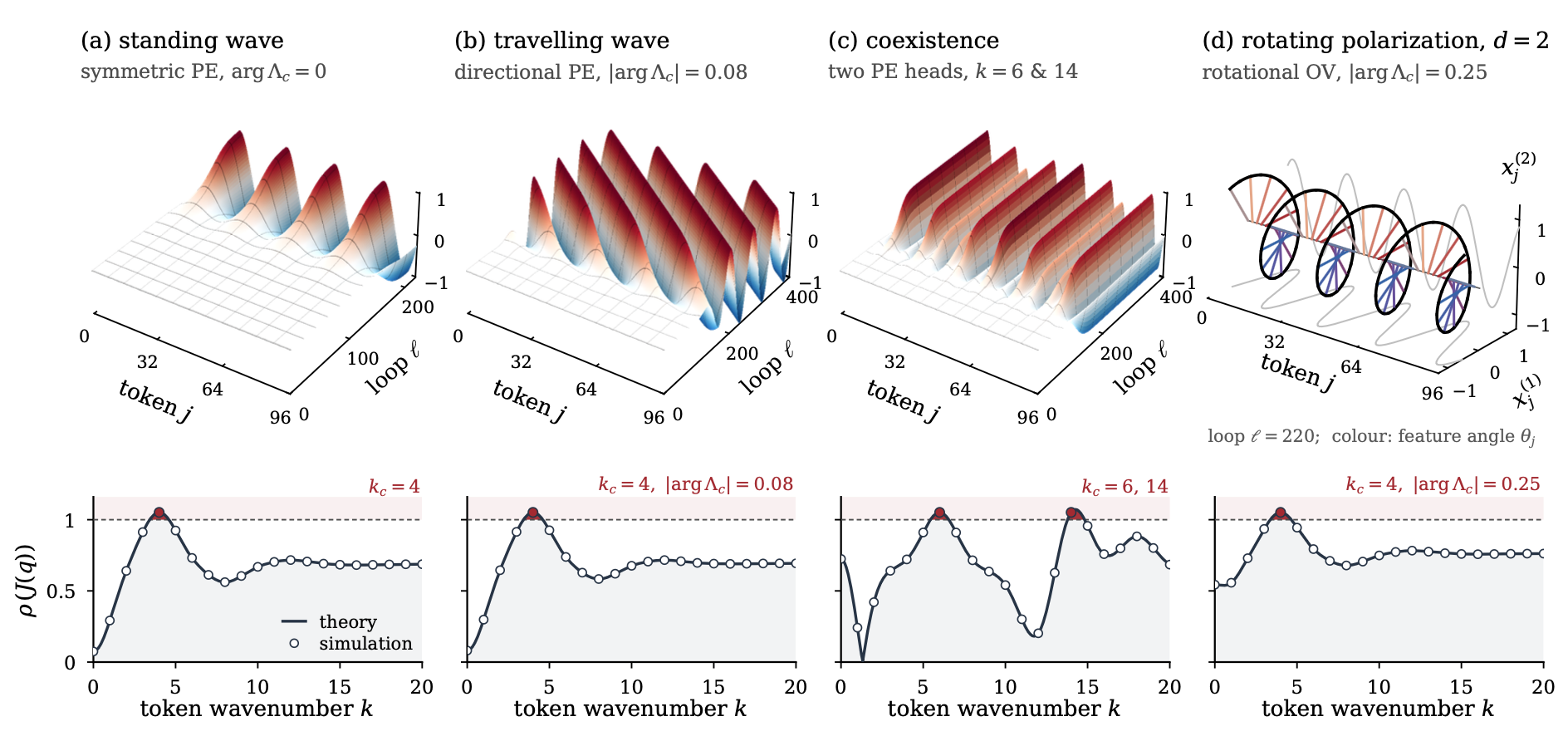
Taxonomy of patterns in Transformers
Taxonomy of patterns in Transformers (top)

07

Pattern formation in Transformers

This work studies the Transformer architecture as a dynamical system: at initialization, its components define an inductive bias that allows for the emergence of token-feature representations.

  • Transformers
  • Representation learning
  • Dynamical systems
  • Inductive Bias
  • Machine learning

DraftPattern formation in Transformers.

What are the inductive biases of a Transformer architecture? Existing theory on how the forward pass shapes representations either considers whether Transformers escape from rank collapse or demonstrates that self-attention drives tokens toward cluster patterns. The latter view arises from an elegant dynamical systems perspective, but relies on simplified architectural assumptions, and does not ex-plain the rich structures observed in practice. This leaves a major open question:when a full Transformer escapes rank collapse, how does it structure token representations? Using pattern-formation theory, we show that the dynamical view of Transformers can account for Positional Encoding, Multi-Head Attention, and Output-Value geometry. We demonstrate that a full Transformer architecture imposes an inductive prior by selectively amplifying a rich set of previously unreported patterns, including traveling or rotating waves among others. We characterize the role of each architectural component in controlling which pattern is amplified, which ones stabilize, compete, or coexist. Finally, we show that these structures can act as a controllable dynamical prior that facilitates learning. By choosing both task-aligned positional encoding and weight initialization, we demonstrate improved data efficiency and accelerated optimization on controlled sequence tasks and with ConViT on CIFAR-10.

Teaching

I am teaching Mathematical Statistics at a L1 level, in Cycle Pluridisciplinaire d'Etudes Supérieures (CPES) at Lycée International de Palaiseau LIPPS.

The course

This course is an introduction to the basic concepts of mathematical statistics, including descriptive statistics, probability theory, and inferential statistics. The following concepts will be covered:

  1. 01

    Descriptive Statistics

    Measures of central tendency (mean, median, mode), measures of dispersion (variance, standard deviation), and data visualization techniques.

  2. 02

    Estimators

    Properties of estimators (bias, consistency, efficiency), maximum likelihood estimation.

  3. 03

    Confidence Intervals

    Construction and interpretation of confidence intervals for population parameters.

  4. 04

    Hypothesis Testing

    Null and alternative hypotheses, Type I and Type II errors, p-values.

Resources

Miscellaneous

Visuals

Music